
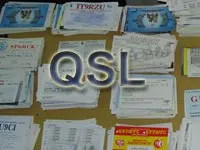
- THAT CARDS BE SORTED BY DXCC COUNTRY and physically separated from one another (with a slip of paper, a label, etc.). Where there is no need for that (where there are only 2-3 cards for a given country), wrap such cards together separately, ALPHABETICALLY or BY PREFIX, and mark them as such (the rest), i.e. physically separate them from the others (wrapping them in rubber bands is not recommended because over time the rubber sticks to the paper.
- Of course, for a DXCC country that has several prefixes, all cards for that DXCC country go together, and they do not have to be arranged by any particular principle (HL, DS, DT, 6M - Korea; ST, 6T - Sudan; YA, T6 - Afghanistan; YI, HN - Iraq; 9V, S6 - Singapore; DU, 4F - Philippines; etc...)
- Every QSL card that has (if it has one, it must be written) a qsl-route, i.e. a qsl manager, is sorted into the DXCC country of the manager. ("4O4A via VE3EXY" goes into "VE", "C31LJ via VE3EXY" goes into "VE", "3V8BB via YT1AD" goes into "YU"...).
If there is none, the manager will write it in later, but if he suspects that it was deliberately (mass) ignored, the sender will be politely reminded for the future.
SPECIAL CONDITIONS:
USA cards should be separated in the following way:
1). all # 1,
2). all # 2,
3). all # 3,
4). all # 4 (with 1 letter in the prefix),
5). all ## 4 (with 2 letters in the prefix),
6). all # 5,
7). all # 6,
8). all # 7,
9). all # 8,
10). all # 9,
11). all # 0,
12). all Alaska (AL, KL, NL, WL),
13). all Hawaii (AH6-7, KH6-7, NH6-7, WH6-7),
14). all Puerto Rico (KP3-4, NP3-4, WP3-4),
15). all other AH, NH, KH, WH 1,2,3,4,5,8,9,0 by number regardless of prefix,
16). all other KP, NP, WP 1,2,5, by number regardless of prefix, while other rare cases/exceptions (KG6DX - Guam, KV4FZ - US Virgin, KH7RS - Kure...as well as KG4 with two letters in the suffix) will be recognized and sorted by the manager during review.
IT IS RECOMMENDED THAT:
- Russia be separated by number/oblast #2, #1, #3, #4, #6, #9 and #0 regardless of prefix,
- Canada be separated by number/area VE-A-B-C-D-F-G-I-J-K,XL-M-N-O,VX,... 1-0, VO1-2, VY1-2,
- Japan be separated by number 1-0 regardless of prefix,
- Australia be separated by number 1-0 regardless of prefix.
OTHER RECOMMENDATIONS :
-*QSL card dimensions are: 140 x 90 m/m (this is the EU standard)
-paper weight (sheet): minimum 110g for ordinary cards, maximum 250g for full-color cards
-*elements included on the card: country name, ITU and WAZ zones, callsign of the QSL card owner, QTH locator (possibly portable), exact address of the card owner, a table for log data that MUST include the official data:
1). CALLSIGN OF THE CORRESPONDENT
2). Date of the contact (European) DD/MM/YYYY
3). Time of the contact (UTC or GMT)
4). Frequency (in "MHz") or band (in "m")
5). Mode (CW/SSB/RTTY/PSK/WSJT/EME/crossband/SWL...)
6). Sent/received readability/signal strength report RS(T)
In the case of a label containing all of the above, the table is not necessary.
Other data that is not necessary but makes sense:
-information about antennas, equipment and other gear,
-some personal data (web site, e-mail, phone/fax number of the owner)
-information about membership in various amateur radio clubs, home, contest, specific (emblems)...
- information about various past amateur radio achievements,
results, participations...
- information about weather conditions and band conditions at the time of the contact, etc.
- information about details with a possible image on the QSL card, etc.
- information about all previous callsigns, etc.
AVOID: offensive and self-aggrandizing content (it only brings us shame, i.e. it benefits no one) recommendation: stick to apolitical motifs.